Friday, November 18, 2011

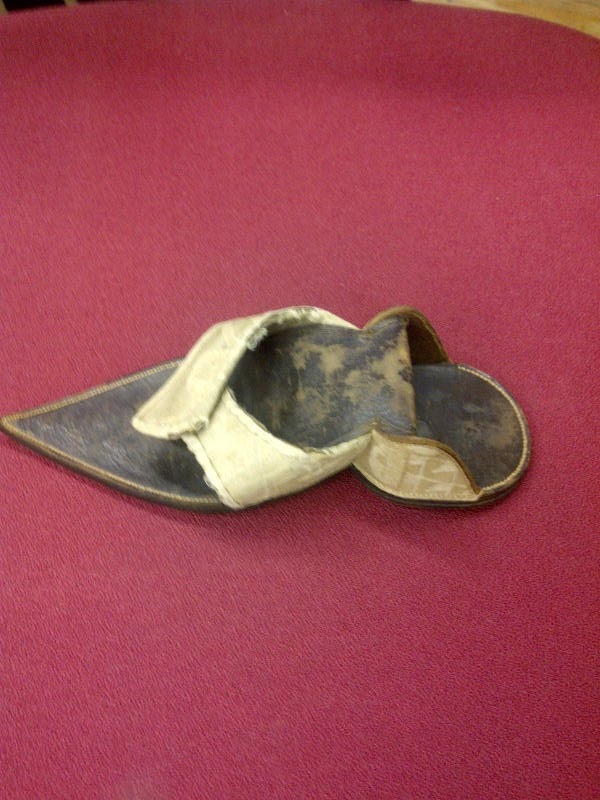
Historic Garment Roundup for November or, Eye Candy for Darker Days

Over the last few weeks, I have had to opportunity to view some stunning and simple historic garments - most in person and some vicariously via electronic mediation.  This is simply a digital inspiration board with 18th and 19th century items drawn from Historic Deerfield, Irma Bowen Collection at UNH, Colonial Willamsburg, the Peabody Essex Museum, the Metropolitan Museum, the Bostonian Society,  and the Museums of Old York. Many thanks for sharing the wealth!


I am finding limitations with the blog format - I would like to be able to layout images in landscape style and offer readers the opportunity to "post" some of their favorites or queries. Does anyone have advice on how I could achieve a more interactive, dynamic piece?  Thoughts would be most welcome.

Wednesday, November 16, 2011

Census Note: Female Heads of Household, Haverhill, NH.

Census records provide a number of opportunities for examining household composition.  In the 1790 Census for Haverhill, we note that Anne Chase, Abigail Eastman, Elizabeth Fifield, Mary Fisk and Mary Simpson were all listed as female heads of household.  The author is currently conducting research into these women while cross referencing them with names of women who make direct purchases from the Montgomery Store in 1793.  Only a very small number of women are listed as making purchases and thus far, the references are for trifling amounts and generally for one item, such as lace (Fanny Bailey) or chintz (Polly Cragge).

In 1790, Haverhill consisted of 101 families totaling 552 residents: 163 free white males over 16, 118 free white males under16, 266 free white females, 1 other and 4 slaves.

Letters from Myra Montgomery of Haverhill to Horace Henry Goodman

Myra and Horace
(For background information on Myra Montgomery, please see 27 September 2011 post.)


Although we have only Myra's letters (and some additions from friends and family) on which to assess the dynamics between the couple, their repartee was quite interesting: her quips, and cajoling; her introspective letters, such as those penned during her final illness and the often playful language, reveal numerous aspects of Myra’s ever contracting world.  For example, she comments: “I told her we expected you here to keep thanksgiving with us and that you would then visit Bath.  You see I am still in the habit of making promises for you, but will not be one of very difficult performance”  Haverhill, November 13, 1815

Horace Henry Goodman was from apparently from West Hartford, Connecticut.  He attended Middlebury and as was in of the top in his class.  During the War of 1812, he was enlisted with Captain Mahurin’s Company, which was under the overall command of Brigadier General John Montgomery of the Western Brigade.  The military connection may be how he met Myra (if not earlier) as the General was connected with all his troops—many of whom were  locally based in Haverhill or Grafton County.  Indeed, Horace’s detachment went with General Montgomery to Portsmouth for  the “defense of the seaboard” in October 1814. 

Following the War, it appears that Horace returns to his active life as a merchant and businessman; not surprisingly, he traveled the eastern seacoast extensively and was able to secure from Boston, Hartford, and other ports imported items important to Myra, her family and friends: Maderia wine; dockroot (for her ailments); black Canton crepe for mourning wear; plumes for a friend’s hat and so on.   Myra writes: “ Mr. West informs us that you have taken a store, and I suppose by this time become quite at home in your new residence”  [Nov. 13, 1815]. The store was located on Long Wharf in Boston and Horace resided at a boarding house of Mrs. Gookin.  The Gookin’s were prominent in Haverhill, but given Gookin’s business interest, they may have had a working relationship as well.  For men like Horace and the Gookin’s the post road along the Coos Turnpike was virtually an expressway, traveled on a regular basis. Horace's business partner, West, was married to Myra's oldest sister, Mary.

Through the letters, we keenly sense Myra’s envy of Horace and his travels when she commented: 
It would greatly enhance the gratification which I receive from your letters, if you would learn from my example to practice a little more egotism.  You seem to imagine I shall only be interested in concerns of primary import and to your welfare, and of which I particularly required an account.  But I should like to know your daily employment, what you read, whom you visit, or whether you visit at all, and how you usually pass your long winter evenings, that I may judge what are the grounds of your preference of a town life to the undisturbed calm in which one is allowed to vegetate in the country
[Haverhill Jan’y 25th 1816]

Or again, her sense of isolation while he is traveling after her mother’s death when she notes:

I have had a charming visit from Mrs. West and Nancy (Ann) though I should like to have been more at leisure to enjoy it.  We have an unusually large family this spring and Eliza is keeping school which makes my task more than ordinarily difficult.  Under such circumstances you will not be surprised nor displeased if my letters are few and far between but consider yourself under still greater obligations to relieve as far as in your power the dull routine of my domestic employment, by frequent communications.  
[Haverhill June 23rd 1816]


To be continued.....


Special thanks to the Haverhill Historical Society 
and Bill and Mary Emig for their generosity.


One of the Montgomery sisters


Installment III: "A bowl of grog, a gill of rum....: A Trader's Accounts

Stephen Couch, Trader from Bath, NH, Visits the Montgomery Store

About six miles away from Haverhill lies the charming village of Bath, NH. While today the town boasts of its long standing general store, clearly the Montogmery Store provided goods and services needed by Mr. Stephen Couch (born abt. 1763-d. 21 April 1813) in the 1790s.


1800 Census, Bath, NH. Note the changes in the family since 1790


Couch appears in the 1790 census in Landaff with a household consisting of two males 16 and over and three females.  This would have included his wife, Anne Edmund (b. 18 March 1764; m. 29 June 1784; d. 6 April 1813), a son (possibly Stephen Edmund) and a daughter (possibly Ann Edward). By the 1800 Census, he is listed in Bath. Couch is clearly a well established presence in the region: by 1793 he makes several substantial purchases from the Montgomery Store in early December (the account does not appear to be reconciled until January 12, 1794.)  Among the items in this large purchase: 50lb coffee, 70lb cotton wool, 2 loaves of sugar, 20lb of allspice, 10lb pepper and 100lbs (?) tea.  In late October and early November, he makes purchase of over 6 bushels of salt, as well as 3 sides of "sole leather."

Apparently, Couch was also invovled with General Montogmery's trip to Concord (see blog entry for 11/17/11) where he sells some of his beef cattle.  The large quantities of coffee, tea, salt, allspice and leather purchased by Mr. Couch would verify his role as a trader, while the substantial purchases of salt would most likely indicate the curing of meats. Couch, like General Montgomery and Col. Johnson, reamined among the wealthiest in the region due to their ability to trade (in cash, goods and services) in Concord and Boston, to own lands for pasturing of cattle and beef and the ability move large quantities of goods and to leverage services.

It is intriguing to note that Mr. Couch dies at the age of 50 and Mrs. Couch at age 49, both in April of 1813 within two weeks of one another.  The possibilty of illness, striking the family, is high. Further research into this possibility is underway.


Thursday, November 10, 2011

Balance and Beauty: Georgian Design in America

Detail of carving, c. 1763. Attributed to Ebenezer Dearing
Courtesy Mark Wentworth Home

Just returned from a wonderful fall forum at Historic Deerfield (www.historic-deerfield.org), "Balance & Beauty: Georgian Design in Early America." Perfect weekend with insightful, informative lectures, thoughtful conversations, thought provoking exhibitions and knowledgeable, gracious and inspiring staff and volunteers. Professionally energizing.

A look at my "inspiration" remix video for "Transatlantic Transformations: Georgian Architecture in Salem and Portsmouth."

http://animoto.com/play/8z6KgB5zMvc76OIfaNPEeg

Inspiration Board: Georgian Architecture New England


 "Transatlantic Transformations: Georgian Architecture in Salem, MA and Portsmouth, NH."

Kimberly Alexander, Ph.D., History Department, University of New Hampshire

Balance and Beauty: Georgian Design in Early America
Historic Deerfield Fall Forum
11-13 November 2011
www.historic-deerfield.org


It is hardly surprising that the Georgian domestic style emerges as the most remarkable in the world.
--Stephen Gardiner


Photographs courtesy: Historic New England, Metropolitan Museum, Peabody Essex Museum, Portsmouth Athenaeum, and Strawbery Banke Museum.

Special thanks: Jim Alexander, Brian Smestad, Richard Candee, James Garvin, Jeff Hopper, Tom Hardiman, Dane Morrison, Tom Stocker and Tara Vose